
Bill Russell Signed Checks: 1970 to 1978 Collector Guide
ZONO BEST’s Bill Russell collection contains eleven original personal checks signed by Russell and dated from 1970 to 1978. Each is presented in a PSA holder, and all eleven are sold together as one collection. Read as a group, they do something a single autograph cannot: they follow one of the most important figures in basketball history through eight years of ordinary life, from the years just after he retired as a champion in Boston, through four seasons coaching the Seattle SuperSonics, and into the year after that job ended.
The story is in the addresses. Seven checks from 1970 and 1971 print a Los Angeles mailing address. One check from 1974 prints a Seattle address marked as a travel account. Three checks from 1978 print a Mercer Island, Washington address. Three addresses, three banks, three chapters, and one signature holding it together.
Quick answer
- What it is: Eleven original personal checks signed by Bill Russell
- Date range: March 1970 to September 1978, eight years
- How they are presented: Each check is in a PSA holder
- What they document: A Los Angeles period after retirement, the Seattle SuperSonics coaching years, and the year after coaching ended
- What to examine: Signature, date, bank and branch, printed account block, payee, amount, reverse-side stamps and endorsements, and the holder
- Important distinction: These are routine-use autographs, not signatures made for fans. The collection is sold as one lot, with no grade or future value promised.
How this article separates fact from inference
Three different kinds of statement appear below, and they are marked so you can tell them apart.
Verified fact is something documented in a public record, such as a hiring date from a coaching record or a founding date from an authentication company's own history. Documentary evidence is what the checks themselves print or carry: a date, a bank name, a branch address, a payee, an endorsement stamp. Reasonable inference is a conclusion that fits the evidence but is not proven by it, such as why a man with a Los Angeles mailing address paid an Indianapolis hotel in 1971.
The distinction matters here. A bank processing stamp proves where a check was handled, not where its writer was standing. A mailing address proves where someone received mail, not where someone slept. Several of the most interesting questions in this collection are genuinely open, and they are labelled as open rather than smoothed over.
Who was Bill Russell?
William Felton Russell was born on February 12, 1934, in Monroe, Louisiana, and died on July 31, 2022. He played center for the Boston Celtics from the 1956–57 season through 1968–69. In 963 regular-season games, he averaged 15.1 points and 22.5 rebounds. He was a five-time NBA MVP, a twelve-time All-Star and an eleven-time NBA champion. (Basketball-Reference)
In April 1966, Russell became the Celtics’ player-coach and the NBA’s first Black head coach. He led the team to championships in 1968 and 1969 while still playing. After retiring as a player, he coached the Seattle SuperSonics from 1973 to 1977, then coached the Sacramento Kings in the 1987–88 season. The Naismith Memorial Basketball Hall of Fame inducted him as a player in 1975 and as a coach in 2021. (NBA.com; Basketball-Reference coaching record)
The collection at a glance
Eleven checks, written across eight years, on three different banks, in two states. The printed account blocks divide them into three distinct chapters, and the divisions are so clean that the checks effectively organise themselves.
| Chapter | Checks | Dates | Account printed on the check | Bank |
|---|---|---|---|---|
| Los Angeles | 7 | March 1970 to November 1971 | c/o Covey & Covey, 9255 Sunset Blvd., Suite 1020, Los Angeles, CA 90069 | United California Bank, Beverly Hills Office, 9601 Wilshire Blvd. |
| Seattle, coaching years | 1 | March 1974 | Travel Account, 221 West Harrison, Seattle, WA 98119 | Seattle-First National Bank, Queen Anne Branch |
| Seattle, after coaching | 3 | June to September 1978 | P.O. Box 58, Mercer Island, WA 98040 | RainierBank, Queen Anne Office, Seattle |
Chapter one: 1969 to 1971, retirement and the Los Angeles years
Russell retired as the Celtics' player and head coach on June 30, 1969, having won his eleventh championship in his final season. In his own account of the years that followed, he moved to Los Angeles after retiring and held Lakers season tickets for four years. The first seven checks in this collection sit squarely inside that period.
All seven were drawn on United California Bank's Beverly Hills office at 9601 Wilshire Boulevard. All seven print the same account block:
William F. Russell c/o Covey & Covey 9255 Sunset Blvd., Suite 1020 Los Angeles, California 90069
Documentary evidence: a documented banking and mailing connection to Los Angeles and Beverly Hills, running from March 1970 to November 1971.
Not established by the checks: that this was Russell's home address. The block reads care of a third party, which is what a business or representative address looks like, and a mailing address is not a residence. Treat the Los Angeles location as well documented and the specific street as his correspondence address, nothing more.
The seven payees read like an ordinary calendar of a man settling into a new city, with one or two entries that invite a question:
| Date | Payee | Amount |
|---|---|---|
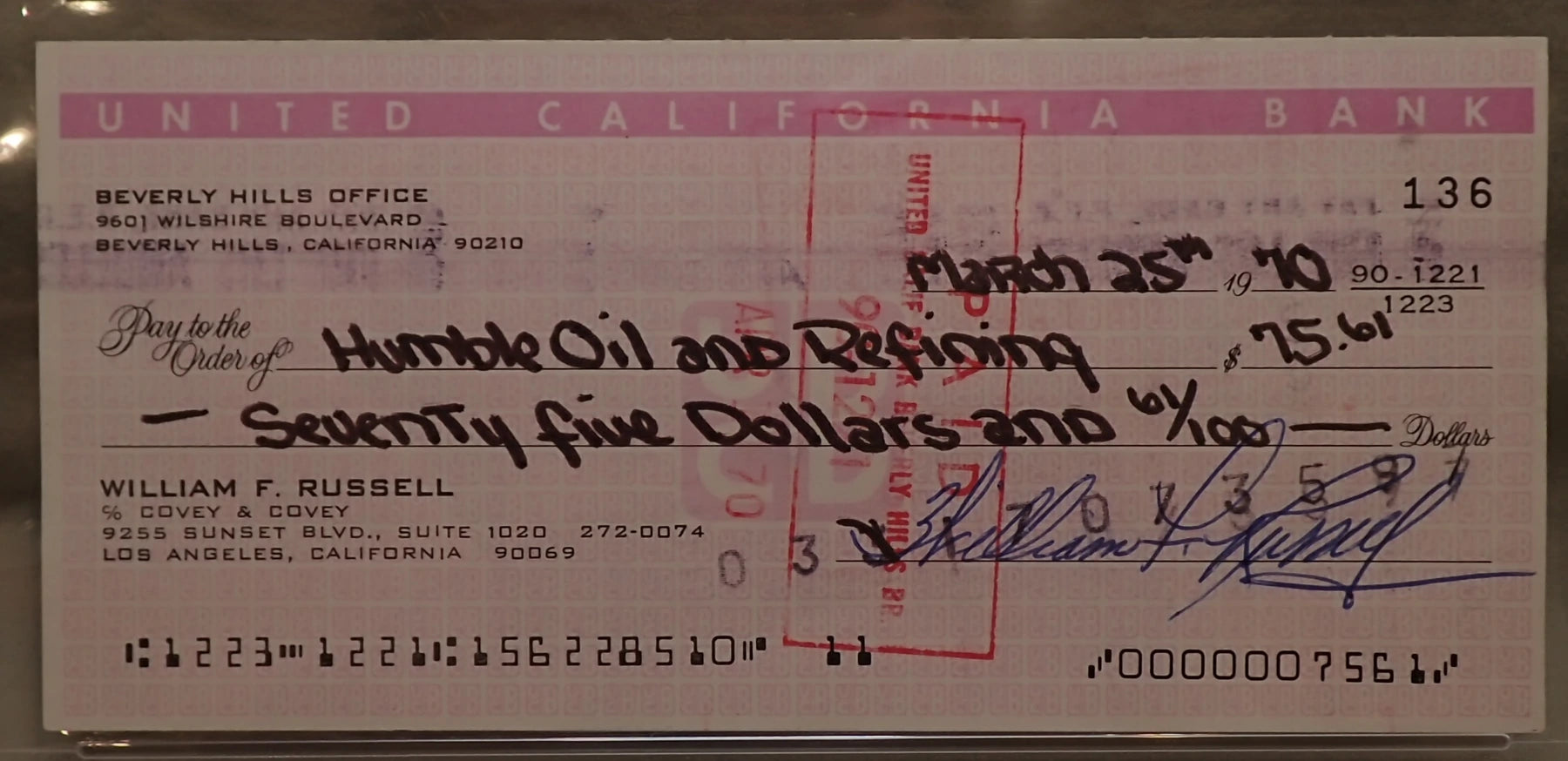
| March 25, 1970 | Humble Oil and Refining | $75.61 |
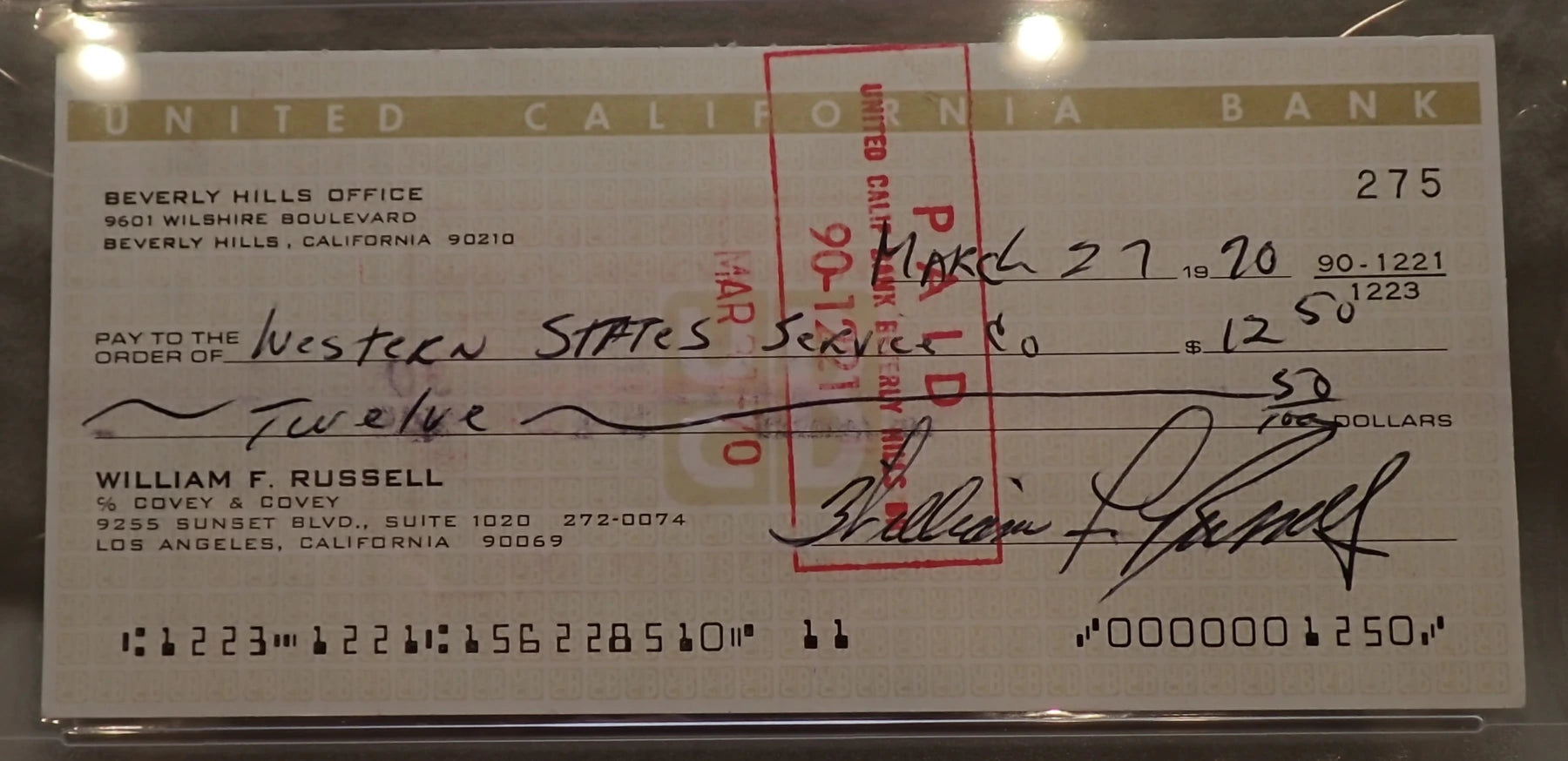
| March 27, 1970 | Western States Service Co. | $12.50 |
| June 26, 1970 | AMARS (Cameras and Recorders) | $32.32 |
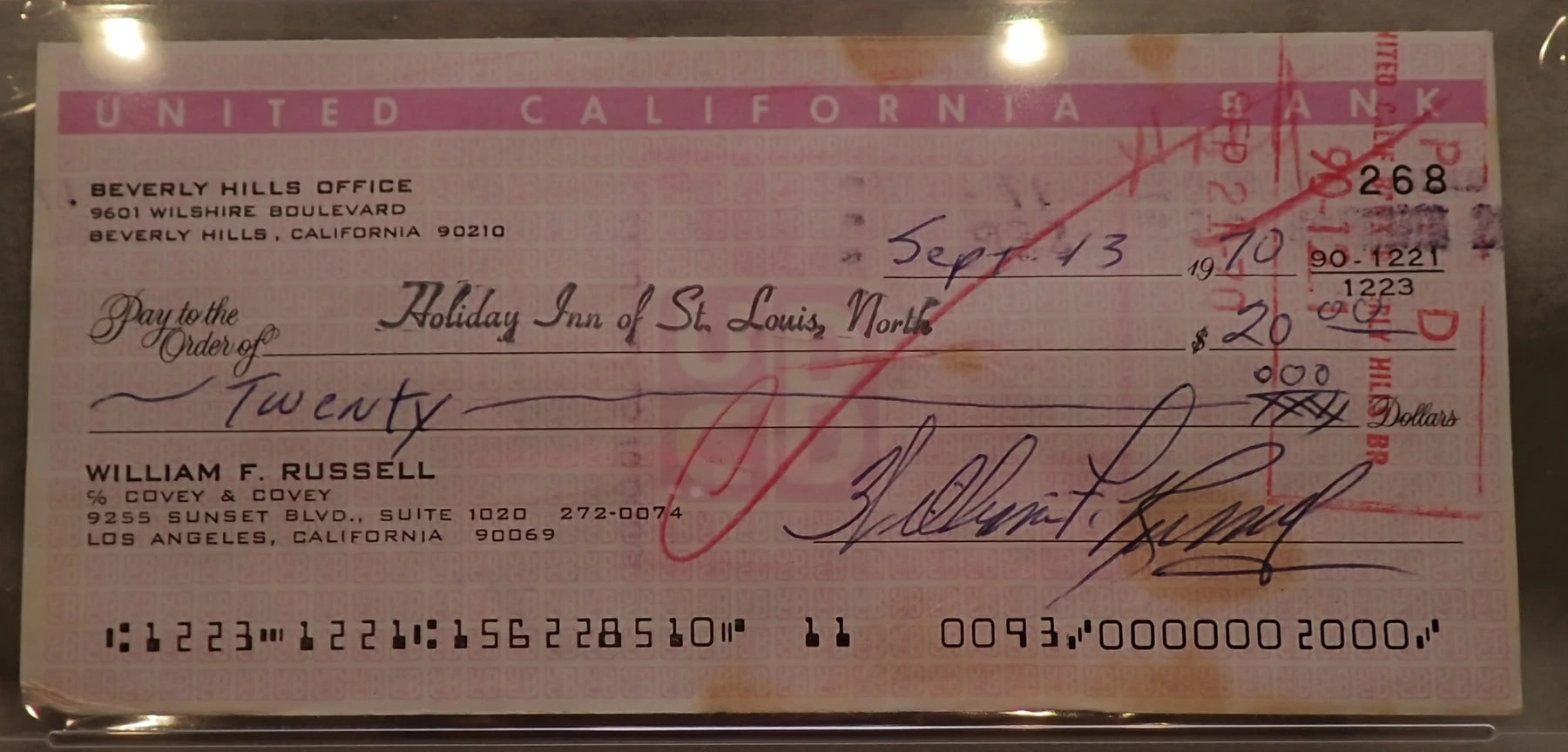
| September 13, 1970 | Holiday Inn of St. Louis North | $20.00 |
| June 20, 1971 | Stouffer's Inn | $50.00 |
| August 10, 1971 | A.B.C. Premiums | $41.48 |
| November 6, 1971 | A.B.C. Premiums | $10.65 |
Two of these are travel payments. A $20.00 check to a St. Louis hotel in September 1970 and a $50.00 check to Stouffer's Inn in June 1971 are consistent with a man on the road, but the checks do not say why he was in either city, and a hotel payment does not prove he stayed there. What they document is that a Los Angeles account was being used to settle hotel bills in Missouri and Indiana.
The two A.B.C. Premiums checks, written ten months apart, both carry a stamp showing the check was paid through the Beverly Hills branch. Our research points toward a Los Angeles appliance and electronics retailer of that name. A connection to the ABC television network has been considered and has not been verified, so it is not claimed here.
Chapter two: 1973 to 1977, coaching the Seattle SuperSonics
Russell was hired to coach the Seattle SuperSonics on May 11, 1973, taking over a team that had just finished 26-56. He stayed four seasons. (HistoryLink; Basketball-Reference coaching record)
The single 1974 check in the collection is the hinge of the whole set, because it is the one item that ties the documents directly to the coaching job:
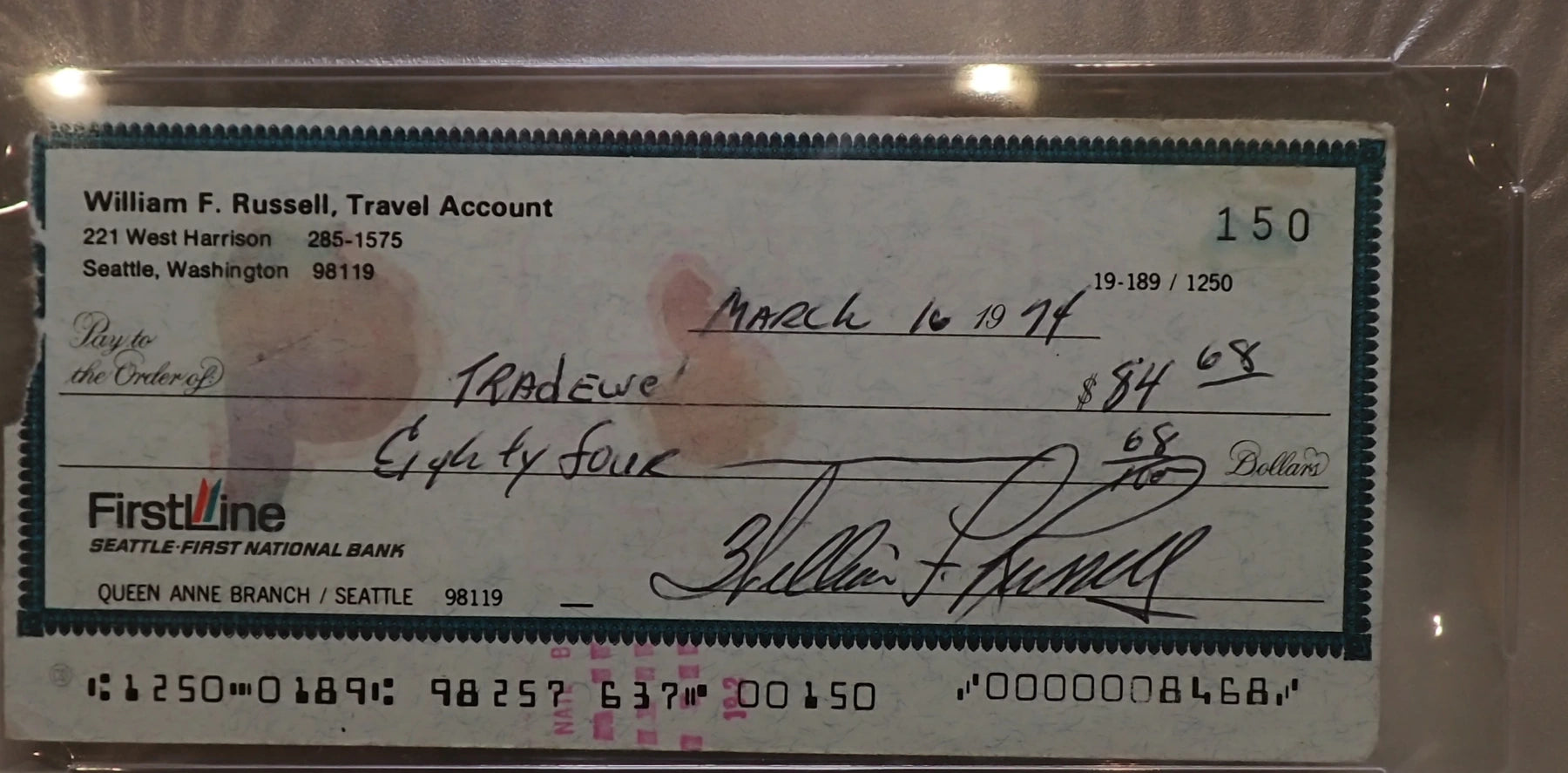
William F. Russell, Travel Account 221 West Harrison Seattle, Washington 98119
Dated March 16, 1974, payable to Tradewell for $84.68, it was drawn on Seattle-First National Bank's Queen Anne Branch. The account block is the detail that matters. It is not a home address line; it reads Travel Account, which is what a team or business travel account looks like, and it locates Russell's Seattle banking inside the city where he was working.
What he was doing that season is a matter of record. In 1973-74, his first year, the SuperSonics went 36-46, a ten-game improvement. In 1974-75 they went 43-39 and reached the playoffs for the first time in franchise history, beating the Detroit Pistons in the first round before losing to the Golden State Warriors in six games. They returned to the postseason in 1975-76 with another 43-39 record. The 1976-77 season ended without a playoff place.
His Seattle record reads 162 wins and 166 losses across four seasons, and his departure is recorded two different ways. Basketball-Reference lists a 40-42 finish in 1976-77 and a resignation dated May 4, 1977; HistoryLink records a 41-41 season and that he was fired. Both accounts are noted here rather than reconciled, because the records genuinely differ.
Chapter three: 1978, after coaching
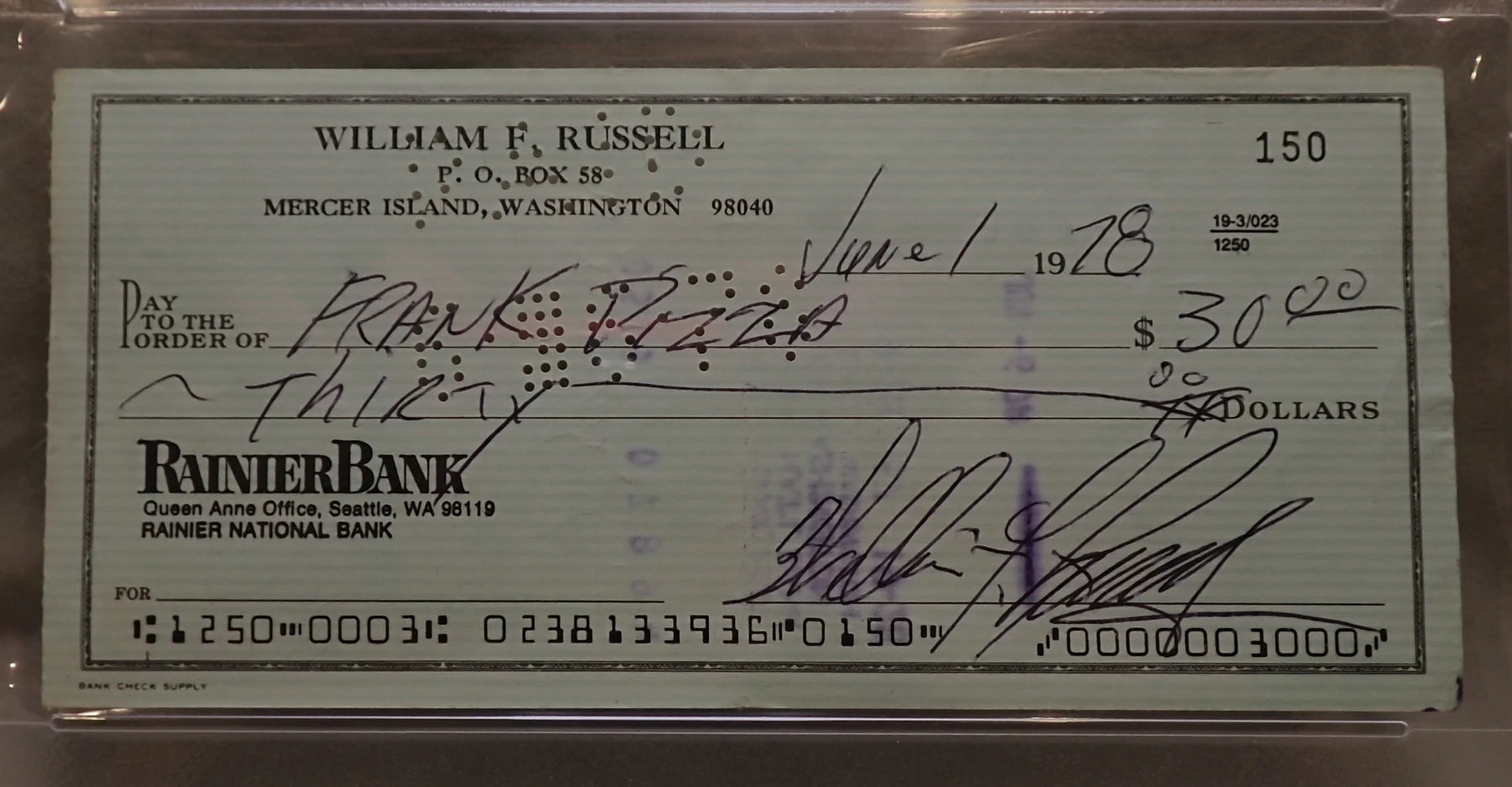
Three checks from June to September 1978 use a third address:
William F. Russell P.O. Box 58 Mercer Island, Washington 98040
All three were drawn on RainierBank's Queen Anne office in Seattle. The important word is continued. Russell's coaching job had ended the previous year, and the checks show that his Washington banking and mailing arrangements carried on past it. That is a small, verifiable thing, and it is the kind of thing that only a run of documents can show.
| Date | Payee | Amount |
|---|---|---|
| June 1, 1978 | Frank Pizza | $30.00 |
| June 29, 1978 | Red Lion | $25.00 |
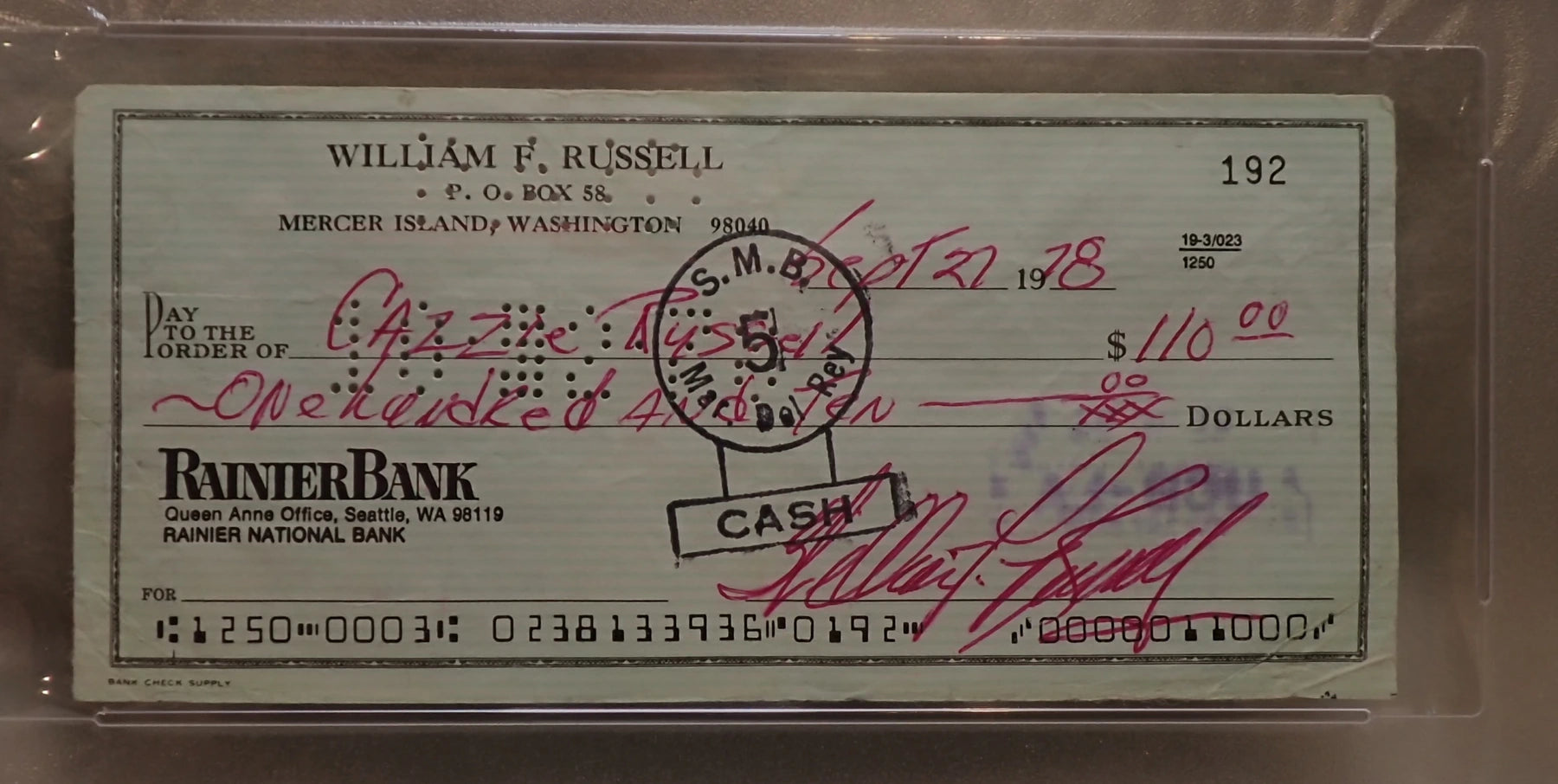
| September 27, 1978 | Cazzie Russell | $110.00 |
The Red Lion check is endorsed to the Jantzen Beach property in Portland, Oregon. That tells you which hotel handled the payment. It does not tell you when Russell was in Portland, or what the payment was for, and both questions stay open.
Frank Pizza appears to be an individual's name rather than a pizza business. A Seattle connection is possible; the person's identity and the reason for the payment are unverified, so nothing further is asserted.
The Cazzie Russell check is the one collectors will look at longest, and it deserves care. Cazzie Russell was born in Chicago in 1944, was the first overall pick of the 1966 NBA draft out of Michigan, and played twelve seasons in the league: five with the Knicks, three with the Warriors, three with the Lakers and one with the Bulls. He was an All-Star in 1972 and won a championship with New York in 1970. By September 1978 his playing career had just ended. (Basketball-Reference)
What is documented is a shared surname and a payment between two men who both had long NBA careers that overlapped. What is not documented is a family relationship between them, or the purpose of the payment. Nothing in the check, and nothing in the record we could find, supports a claim about either, so neither is made here.
The businesses and people behind the payees
Half the interest of a collection like this is in the other names on the paper.
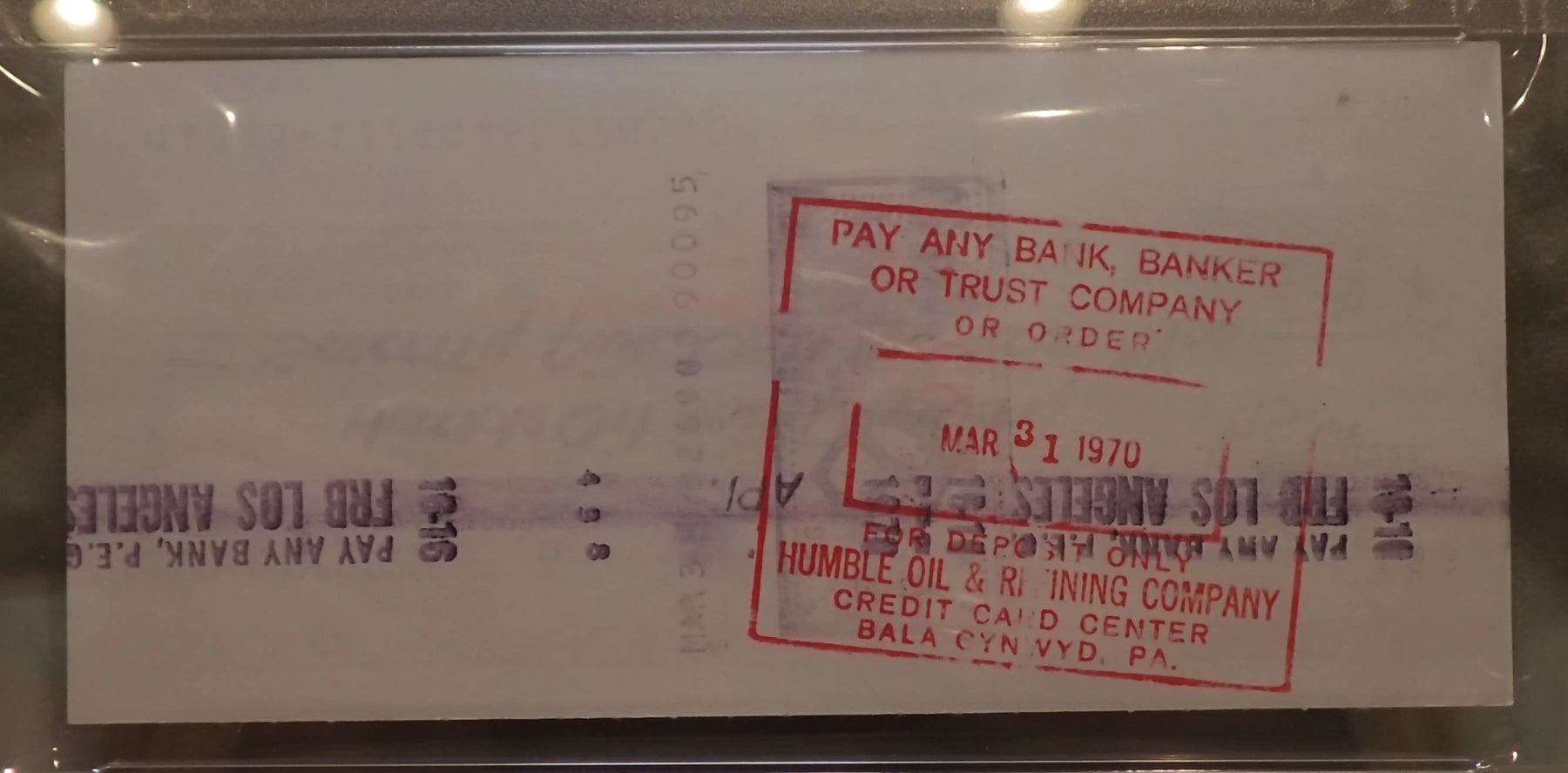
Humble Oil and Refining was the principal domestic refining subsidiary of Standard Oil Company (New Jersey), and the name was in use through 1972 before the company's operations moved to the Exxon name. The reverse of the March 1970 check carries a red stamp for the company's credit card centre in Bala Cynwyd, Pennsylvania, dated March 31, 1970: six days from writing to processing. (Texas State Historical Association)
Western States Service Co. matches to 5707 Santa Monica Boulevard in Los Angeles in period advertising, a short drive from the Wilshire Boulevard bank branch that cleared the check.
AMARS appears in our research as a cameras and recorders business, consistent with a $32.32 purchase in June 1970.
Tradewell was a Seattle-area grocery chain, which makes the 1974 check an ordinary household payment written on a travel account.
RainierBank and Seattle-First National Bank were both Seattle institutions. Seattle-First, better known as Seafirst, was acquired by Bank of America in 1983, and the Seafirst name was retired at the end of the 1990s. United California Bank later became part of First Interstate Bank, which Wells Fargo acquired in 1996. None of that changes the checks, but it is why the bank names on them no longer exist on any high street.
Why do everyday documents interest collectors?
A signed photo or card is usually created with a fan or collector in mind. A check was signed to move money. That makes the signature feel more routine and unposed, and the document can connect it to a specific date, bank, payee and transaction.
Those surrounding details give collectors more to study than a signature alone. They can make a convincing forgery more difficult to construct than a signature on a blank or generic item, but they do not prove authenticity by themselves. The appeal here is context, not a claim that the checks are uniquely scarce.
A signed personal check is also a different kind of autograph from a signed photo or game-used item. Depending on the item and market, checks are often more affordable than those formats. That is a general distinction, not a statement about future value or a promise of resale price.
How can you read a signed check like a collector?
Look at the whole document, not just the signature. Useful details include:
- Date and bank imprint: Compare the date with the bank name and branch. The 1970 examples name United California Bank’s Beverly Hills Office; the 1978 examples name Rainier Bank’s Queen Anne Office in Seattle.
- Printed account name and address: The 1970 checks show “William F. Russell” and a Los Angeles account block. The 1978 example lists Mercer Island, Washington.
- Payee and written amount: The March 25, 1970 check names Humble Oil and Refining for $75.61. The June 29, 1978 check names Red Lion for $25.00.
- The handwritten amount in words: Check that the figure and the written-out amount agree, then compare both with the signature.
- Signature versus printed name: The printed account name identifies the account holder; it is not the handwritten signature. Look for the signed portion of the check.
- Reverse-side stamps and endorsements: The back of the March 1970 check has a red stamp reading “HUMBLE OIL & REFINING COMPANY / CREDIT CARD CENTER / BALA CYNWYD, PA.” and a MAR 31 1970 date stamp. The September 1978 check carries a CASH stamp dated 9/25/78.
- Holder: Note whether the item is presented in its authentication holder and whether available identifying information can be checked with the authenticator.
What does PSA authentication tell you, and what doesn’t it tell you?
PSA, or Professional Sports Authenticator, began in 1991 and is a division of Collectors Universe. It authenticates and grades collectibles, including autographs and memorabilia, and presents items in holders. (PSA About PSA)
A holder is useful, but read the listing and the holder details carefully. Authentication and grading are different from valuation: a holder does not establish what an item will sell for in the future. Where a PSA certification number is available, use PSA’s certification verification page to check the record. No grade or certificate number is specified here for this collection. It is sold as one lot, and no grade or future value is promised.
The timeline, with the checks in place
Set the eleven documents against the record and the shape of the collection becomes clear. The checks are not evenly spread across eight years; they cluster in the two quiet periods either side of a job, with a single item landing in the middle of it.
| Date | Event | In the collection |
|---|---|---|
| February 12, 1934 | Born in Monroe, Louisiana | |
| 1956–57 to 1968–69 | Plays center for the Boston Celtics; eleven championships | |
| April 18, 1966 | Named Celtics player-coach, the NBA's first Black head coach | |
| June 30, 1969 | Retires as player and head coach | |
| 1969–1971 | Los Angeles period; Lakers season tickets for four years by his own account | 7 checks, United California Bank, Beverly Hills |
| March 25, 1970 | Humble Oil and Refining, $75.61, processed March 31 | Check 1 |
| September 13, 1970 | Holiday Inn of St. Louis North, $20.00 | Check 4 |
| November 6, 1971 | A.B.C. Premiums, $10.65, the last Los Angeles check | Check 7 |
| May 11, 1973 | Hired to coach the Seattle SuperSonics | |
| March 16, 1974 | Tradewell, $84.68, written on a Seattle travel account | Check 8 |
| 1974–75 | Sonics reach the playoffs for the first time in franchise history | |
| May 4, 1977 | Leaves the Sonics coaching job | |
| June 1, 1978 | Frank Pizza, $30.00, Mercer Island account | Check 9 |
| September 27, 1978 | Cazzie Russell, $110.00, the last check in the set | Check 11 |
| 1975 and 2021 | Hall of Fame induction as a player, then as a coach | |
| 1987–88 | Coaches the Sacramento Kings | |
| July 31, 2022 | Dies at 88 |
The complete collection
All eleven checks, in order, as they are offered:
| # | Date | Payee | Amount | Account and bank |
|---|---|---|---|---|
| 1 | March 25, 1970 | Humble Oil and Refining | $75.61 | Los Angeles c/o Covey & Covey; United California Bank, Beverly Hills |
| 2 | March 27, 1970 | Western States Service Co. | $12.50 | As above |
| 3 | June 26, 1970 | AMARS | $32.32 | As above |
| 4 | September 13, 1970 | Holiday Inn of St. Louis North | $20.00 | As above |
| 5 | June 20, 1971 | Stouffer's Inn | $50.00 | As above |
| 6 | August 10, 1971 | A.B.C. Premiums | $41.48 | As above |
| 7 | November 6, 1971 | A.B.C. Premiums | $10.65 | As above |
| 8 | March 16, 1974 | Tradewell | $84.68 | Travel Account, 221 West Harrison, Seattle; Seattle-First National Bank, Queen Anne |
| 9 | June 1, 1978 | Frank Pizza | $30.00 | P.O. Box 58, Mercer Island; RainierBank, Queen Anne |
| 10 | June 29, 1978 | Red Lion | $25.00 | As above; endorsed to the Jantzen Beach property |
| 11 | September 27, 1978 | Cazzie Russell | $110.00 | As above; cash stamp dated 9/25/78 |
Looking at the collection at ZONO BEST
The eleven checks are offered together as a single collection at $6,350, each in a PSA holder, with front and reverse photographs of every item in the listing. Taken together they cover eight years, three addresses, three banks and the whole arc between a championship retirement in Boston and the quiet year after a coaching job in Seattle ended.
You can see the full listing, all the photography and the current details here: Bill Russell signed check collection.
You can also browse the broader signed memorabilia collection, sports cards collection and collectables collection.
Related guides
- What is moissanite? for buyers comparing stones in jewelry.
- Cartier Santos with diamonds: original vs aftermarket on how documentation should and should not be read.
FAQ
Are checks signed by athletes collectible?
They can interest collectors because they combine an autograph with a dated financial document and transaction details. The appeal depends on the signer, the item, its condition and the available authentication information.
How do I verify a PSA-certified autograph?
Check the certification information on the holder against PSA’s certification verification page, when a number is available. Review what the record actually confirms; don’t assume authentication establishes future value.
What is the difference between a signed check and a signed photo?
A personal check was signed for a transaction, not for a fan. A signed photo is generally an item created or presented for an autograph. The check’s routine-use context is part of its interest.
Why are the checks dated 1970 to 1978 significant?
Because they span a transition rather than a single moment. Seven come from the Los Angeles years that followed his retirement in 1969, one comes from the middle of his Seattle SuperSonics coaching tenure, and three come from 1978, after that job had ended and he was still banking in Washington. No single check tells that story; the run does.
Was Covey & Covey Bill Russell's home address?
The checks print 9255 Sunset Boulevard, Suite 1020 as a care-of address, which is what a representative or business address looks like. It documents a Los Angeles mailing and banking connection between 1970 and 1971. It should not be read as his residence.
Sources
- Bill Russell player page, Basketball-Reference
- Bill Russell coaching record, Basketball-Reference
- Cazzie Russell player page, Basketball-Reference
- Seattle SuperSonics hire Bill Russell as head coach on May 11, 1973, HistoryLink
- Bill Russell Hall of Fame profile, NBA.com
- Bill Russell named Celtics player-coach, NBA.com
- About PSA, Professional Sports Authenticator
- Exxon Company, U.S.A., Texas State Historical Association
A note on sources: dates of employment and season records come from Basketball-Reference's coaching record and HistoryLink's essay on the 1973 hiring, which are also the two sources that disagree on how the Seattle tenure ended. Payee and address details come from the checks themselves, read from the photographs in the ZONO BEST listing. Where the two kinds of source leave a question open, it is left open in the text above.